We study the exotic optical and electronic properties of quantum materials, with a particular focus on semiconductor quantum dots and other nanoscale systems in which new behavior emerges from the coupled dynamics of electrons, excitons, photons, and the lattice.
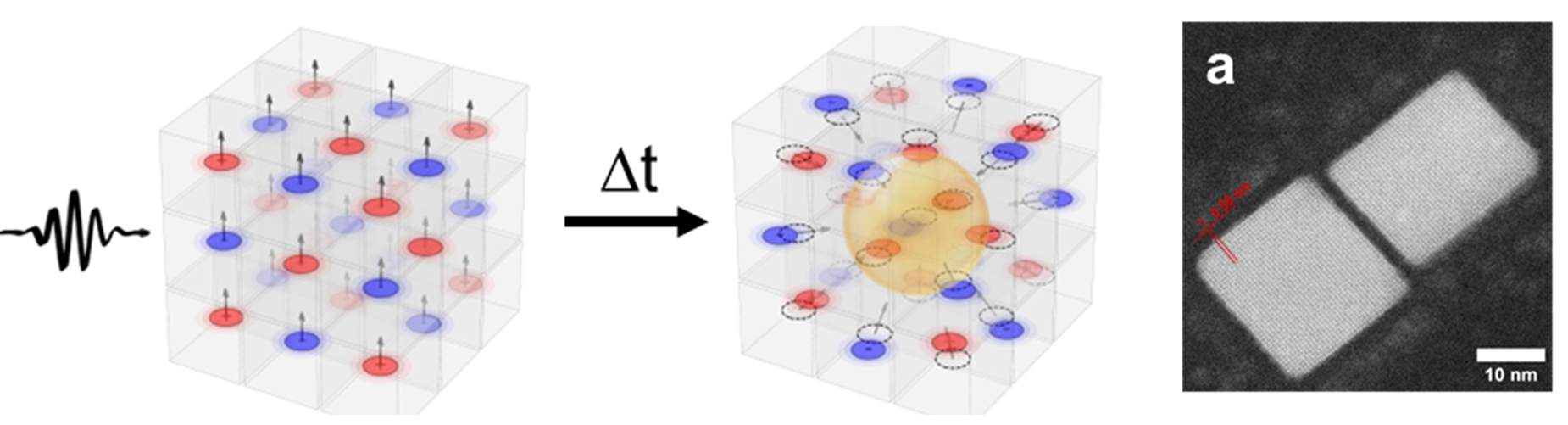
Our central interest is not merely how materials absorb and emit light, but how light can drive the formation of new quantum states. In these systems, an optical excitation is not simply placed into a passive material. Instead, the material reorganizes around it. Electronic states, lattice polarization, coherence, and collective optical response can emerge dynamically, producing phenomena that cannot be understood from single-particle pictures alone.
This is the physics of quantum materials: many-body interactions, emergent quasiparticles, collective optical effects, and dynamical state formation.
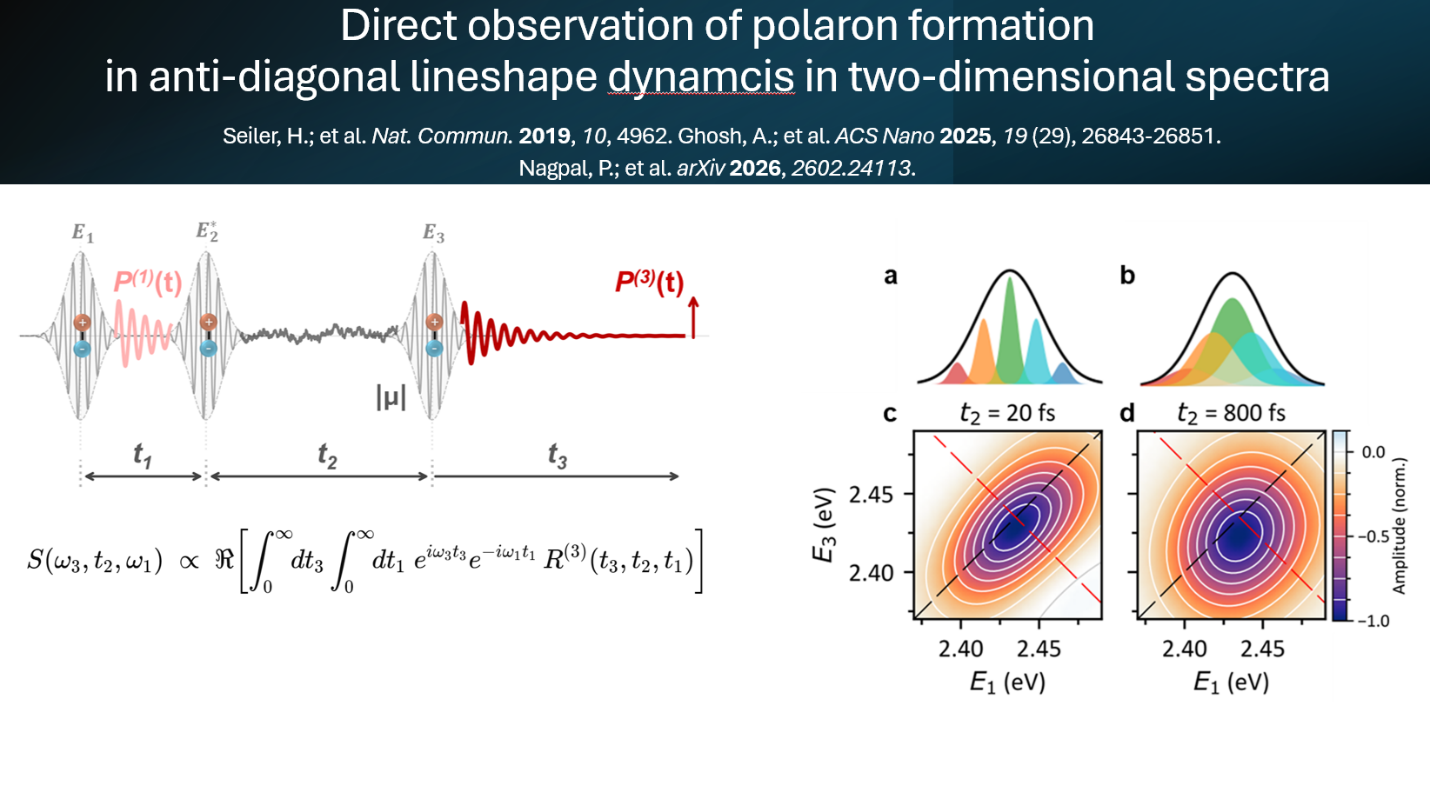
The group develops and applies some of the world’s most sophisticated optical spectroscopies for studying quantum materials in real time. Our experimental platform combines coherent multidimensional spectroscopy, ultrafast transient absorption, multipump nonlinear spectroscopy, time-resolved photoluminescence, cryogenic spectroscopy, and state-resolved optical pumping.
These methods allow us to follow quantum dynamics from the first femtoseconds after photoexcitation to the eventual formation of measurable optical function. We can resolve coherent couplings, homogeneous linewidths, spectral diffusion, multiexciton structure, stimulated emission, excited-state absorption, radiative dynamics, and collective light–matter response.
The goal is simple but demanding: to see what the material is actually doing, rather than infer it indirectly from simplified models.
Our experiments are designed to produce discovery-grade observations: measurements that reveal new physical phenomena, expose the limits of existing models, and require new conceptual frameworks.
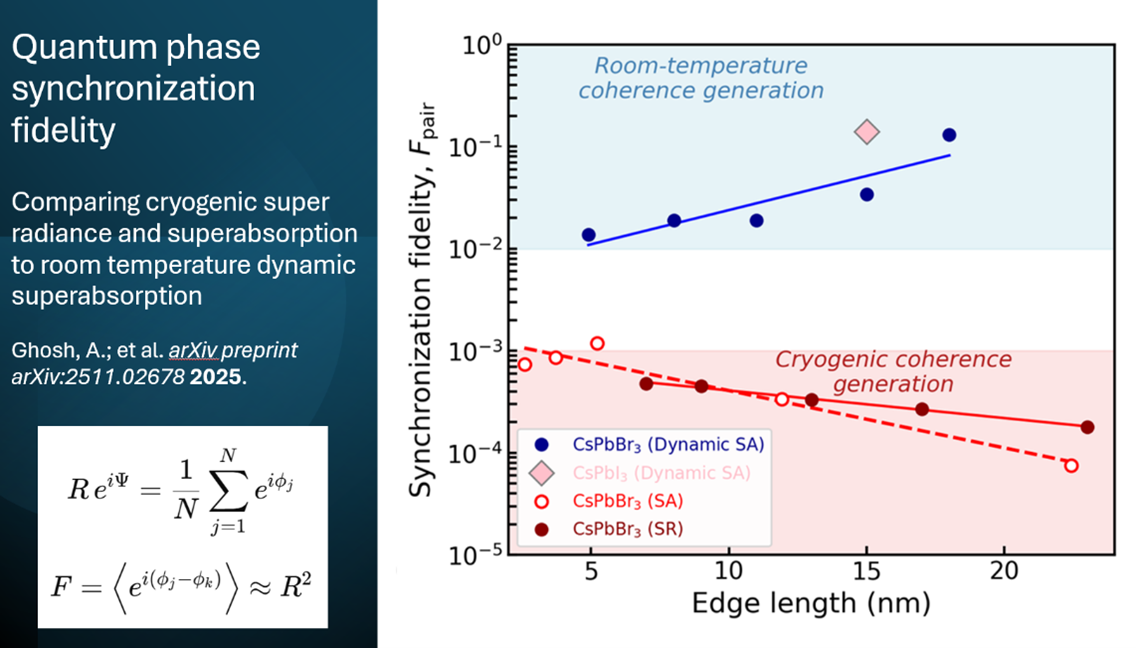
We study problems such as the real-time birth of Landau polarons, emergent electronic coherence in soft polar lattices, superradiance and superabsorption in perovskite quantum dots, multiexciton physics, quantum-optical gain, and nonlinear optoelectronic response.
A defining feature of the group is the tight integration of experiment and theory. We use spectroscopy as a direct probe of quantum dynamics, and we develop analytic models that connect measured observables to microscopic physical mechanisms.
Artificial intelligence now plays a central role in this process. We use AI as a co-discovery engine: not as a replacement for physical intuition, but as an amplifier of it. AI-assisted reasoning helps us derive models, test interpretations, generate alternative explanations, connect ideas across fields, and accelerate the movement from experimental observation to theoretical understanding.
Our work is embedded in a broader international ecosystem of quantum-materials science. We partner with leading materials suppliers, synthetic chemists, quantum-dot experts, and ab initio theorists to study materials of exceptional quality and to connect experimental observables to microscopic electronic structure.
This collaborative structure allows us to ask questions that cannot be answered by spectroscopy alone, synthesis alone, or theory alone. The group sits at the interface of physical chemistry, condensed-matter physics, quantum optics, materials science, and nonlinear spectroscopy.
The Kambhampati Group provides a platform for excellent, motivated PhD students and postdoctoral researchers to do world-class science.
Students are trained to think independently, build and use advanced instruments, analyze complex data, develop physical models, write at a high level, and communicate ideas clearly. They learn how to move from raw experimental observations to conceptual claims that can change how a field thinks.
The training is intentionally broad. Alumni of this kind of environment are prepared not only for academic careers and faculty positions, but also for high-level careers in technology, finance, consulting, data science, instrumentation, intellectual property, entrepreneurship, and scientific leadership.
The common thread is rigorous thinking. Students learn to attack hard problems, separate signal from noise, build models from evidence, and communicate complex ideas with force and clarity.
At its core, the group asks one question: How does a material create a new quantum state after absorbing light?